
Tech Innovations Shaping the Future of the FIFA World Cup
Published July 19, 2026 · 7 min read · Updated July 19, 2026
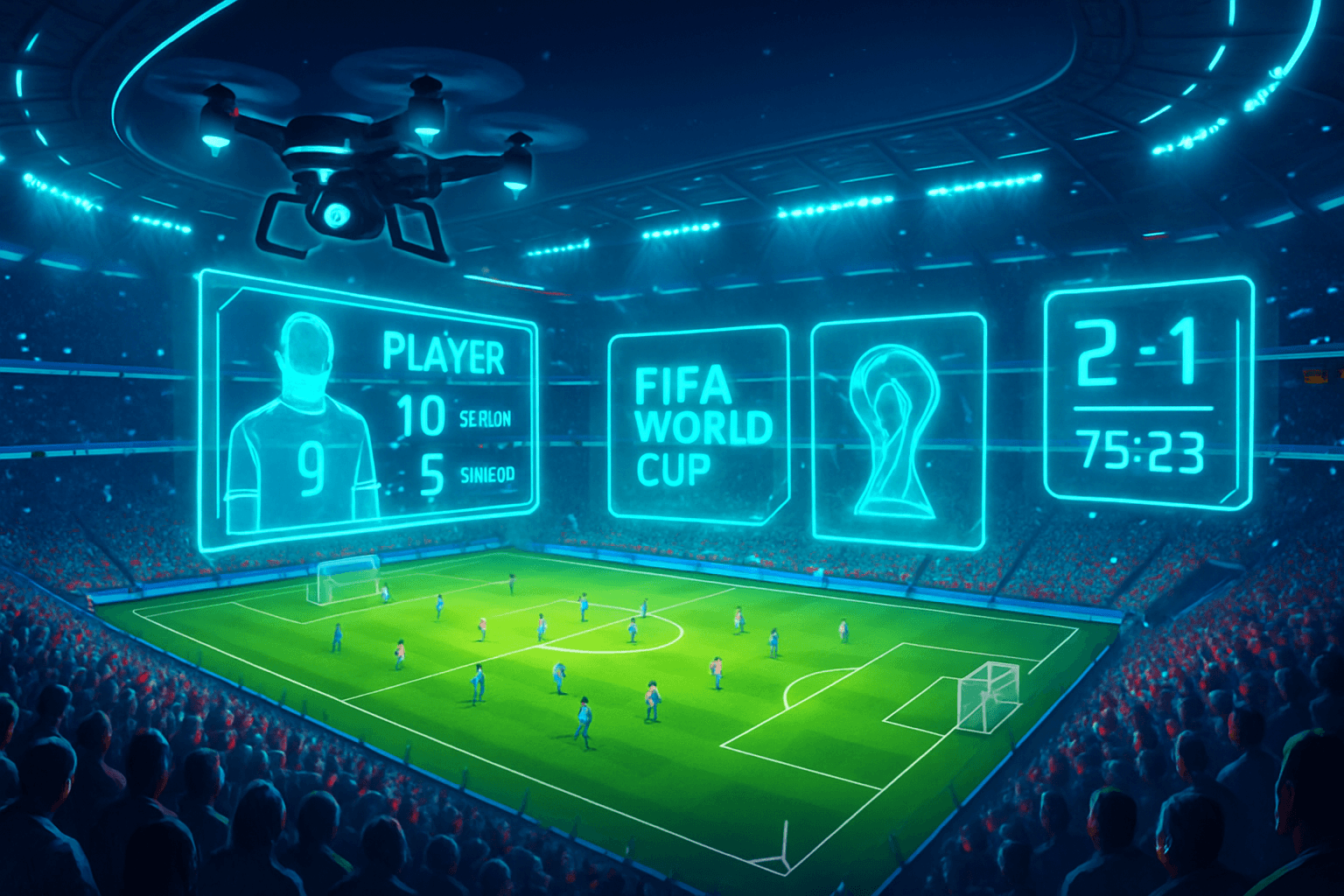
The 2022 World Cup in Qatar was the first tournament where semi-automated offside technology caught a goal that the human eye — and every camera angle available to commentators — initially missed. The system tracked 29 data points on each player's body, 50 times per second, and flagged the call in under a minute. That's not a gimmick. That's a fundamental shift in how a 100-year-old sport gets officiated.
And it's just the beginning.
The 2026 World Cup, spread across the U.S., Canada, and Mexico, will be the largest in history — 48 teams, 104 matches, three countries. Coordinating that beast requires more than logistics. It requires technology baked into every layer of the tournament, from how fans navigate stadiums to how coaches make substitutions to how broadcasters tell the story. Here's what's actually being built.
AI on the Pitch: From Offside Calls to Tactical Intelligence
FIFA's semi-automated offside technology (SAOT) was the headline act in Qatar, but the underlying system is more interesting than the press coverage suggested. It combines dedicated limb-tracking cameras with a ball chip that sends positional data at 500 Hz. An AI model then reconstructs a 3D skeleton of every player on the pitch and freezes the frame at the exact moment the ball is played — not when a human reviewer hits pause, but when the system detects contact.
The result? Offside decisions that used to take 5+ minutes with VAR now take under 60 seconds.
But that's the defensive application. The offensive one is where things get genuinely interesting. Clubs like Liverpool, Manchester City, and Bayern Munich already use similar tracking data — sourced from companies like Statsperform and Second Spectrum — to build tactical models. Player heat maps, pressing intensity metrics, expected threat (xT) values — these aren't just analyst toys. Managers actually adjust formations based on them at halftime.
For 2026, expect FIFA to expand the data broadcast layer. The plan is to make near-real-time positional data available not just to broadcasters but potentially to fans through companion apps. Imagine watching a World Cup match and being able to pull up a live tactical overlay showing how Argentina's press is performing against France's build-up. That's not science fiction — it's an engineering problem that's largely already been solved at the club level.
The real question is whether FIFA can democratize that data or will keep it locked behind broadcast rights deals.
Blockchain and the War on Ticket Fraud
The 2022 Qatar World Cup saw FIFA partner with Algorand for its official blockchain infrastructure. That relationship extended to digital collectibles (NFTs), but the more practical application was around ticketing and credential verification.
Ticket fraud at major tournaments is a genuine problem. The 2018 World Cup in Russia saw a secondary market flooded with counterfeit tickets. Blockchain-based ticketing solves this by making each ticket a non-transferable or conditionally-transferable digital asset — the provenance is verifiable on-chain, and the terms of transfer are enforced by smart contract rather than by a human at a gate scanner.
FIFA's approach with Algorand used a hybrid model: tickets existed as digital assets, but the identity verification layer sat off-chain. That's actually the right architecture. You don't want personal identity data on a public ledger — you want the proof of valid ownership on-chain, with the identity check happening at the point of entry through a trusted verifier.
For 2026, the ticketing infrastructure will need to handle a significantly larger scale — three host countries means three different regulatory environments for digital assets, three different consumer protection frameworks, and three different levels of crypto adoption among the fan base. Mexico City fans and suburban New Jersey fans don't have the same relationship with digital wallets.
The interesting design challenge: how do you build a blockchain-backed ticketing system that works for someone who's never touched crypto? The answer is probably abstracted custody — users get the security benefits of on-chain ownership without needing to manage a seed phrase. Think of it like how you use a credit card without understanding ISO 8583.
The Stadium Experience Gets a Software Upgrade
The AT&T Stadium in Arlington, Texas — one of the 2026 venues — has over 10,000 access points in its Wi-Fi network. That's not a coincidence. Dense connectivity is the prerequisite for everything else on this list.
With that connectivity comes a rethink of the fan experience from the ground up:
- Cashless payments are standard now, but the next step is frictionless. Some venues are experimenting with palm-vein recognition for payments — you register your card to your hand, and you pay by hovering over a scanner. No phone, no wallet.
- AR wayfinding inside massive stadiums is a solved problem technically, but adoption has been slow. Expect 2026 venues to push harder on apps that help fans navigate 80,000-seat venues without getting lost or missing kickoff.
- Dynamic pricing for concessions based on queue length and match time — already tested in NFL venues — means a beer might cost more at halftime than at the 85th minute. Controversial with fans, but operationally it reduces crush at peak times.
- Broadcast quality streams inside stadiums so fans in the upper deck can actually see a replay in detail. This sounds basic, but getting low-latency, high-quality video to 80,000 simultaneous users on a single network is genuinely hard.
The underlying theme: stadiums are becoming software platforms. The physical structure matters less than the digital layer running on top of it.
Performance Monitoring and the Ethics of Data-Driven Athletes
Every professional player at the 2026 World Cup will generate an extraordinary amount of biometric data. GPS vests track distance covered, sprint speeds, and acceleration loads. Heart rate monitors feed into fatigue models. Some systems now track neuromuscular readiness — essentially how recovered an athlete's nervous system is — using HRV (heart rate variability) measured during sleep.
The legitimate use case: prevent injuries. The 2022 tournament's compressed schedule (caused by the November-December timing) led to a wave of muscle injuries. Teams with better load management data made better substitution decisions and avoided burning out players in the group stage.
The harder question: who owns that data? A player's biometric information is arguably more personal than their financial records. Right now, the data collected during a tournament largely belongs to FIFA and the clubs, not the players. That's a legal and ethical gap that player unions are starting to push back on — and it's the kind of issue that will need a real framework, not just a terms-of-service clause, before 2026.
For the technically minded: the architecture here is interesting. Real-time biometric data needs to flow from wearables → edge processing → coaching staff tablets with sub-second latency. During a match, you can't have a cloud round-trip. That means local processing at the stadium level, with sync to central systems at halftime and post-match.
The Takeaway
The 2026 World Cup won't just be the biggest football tournament ever staged — it'll be the most instrumented sporting event in human history. Every pass tracked, every ticket verified on-chain, every fan's movement through the venue logged and optimized.
That creates genuine value: faster officiating, cleaner ticketing, safer players, better fan experiences. But it also creates a data footprint that nobody has fully reckoned with yet.
If you're a developer, there's real work to be done here — in latency-sensitive sports data pipelines, in abstracted blockchain UX, in privacy-preserving biometric systems. If you're a fan, the question worth asking is: how much of your experience do you want optimized, and at what cost to spontaneity?
The best moments in football — the ones people remember for decades — weren't engineered. Technology should serve the game. The moment it starts managing it, something important gets lost.
Popular posts
Could Spero Therapeutics Be Biotechs Next Takeover Target?
Could Spero Therapeutics be biotech’s next buyout play? Get the key catalysts, pipeline signals, and deal clues that could make Spero a takeover target.
What to Pack for a 5-Day Snowboarding Trip if Youre a Beginner
A beginner-focused guide that explains not just what to pack, but why each item matters. Include rental-vs-bring decisions, first-trip mistakes, weather planning, and comfort items that help new riders stay warm, dry, and confident for five full days.
LLM Evaluation in Production: Metrics, Failure Modes, and Guardrails That Actually Matter
Move beyond benchmark scores and learn how to evaluate LLMs in real deployments. Cover task-specific metrics, human review loops, hallucination detection, regression testing, safety checks, and cost-latency-quality trade-offs for teams shipping AI features.